
The dance must have originated from Bukidnon, northeastern Mindanao since they are performed as an entertainment for the deities in fiestas organized for them.It was originally thought that this dance was performed only during harvest time or upon the birth of a male heir. Women would wear colorful feathered head dresses, plaid costumes and anklets. They would step rhythmically around a bamboo arch decorated with newly-gathered palay (rice stalks) and corn, and their movements are emphasized by the tinkling sounds from the anklets.
videocredit: Kfgcatanauan
Technorati tags:
Philippine Folk Dance,,tinikling,singkil,itik,binasuan,pandango sa ilaw,sayaw sa bangko,carinosa,kalapati,kuratsa,dugso
Tuesday, July 24, 2007


Monday, July 23, 2007
Kuratsa
Kuratsa
This is a dance that originated from Bohol, Visayas but it is also popular at Ilokano festivals.
This dance commands a sense of improvisation which mimics a young playful couple's attempt to get each other's attention. It is performed in a moderate waltz style.
videocredit: Saiaoppinoi
Technorati tags:
Philippine Folk Dance,,tinikling,singkil,itik,binasuan,pandango sa ilaw,sayaw sa bangko,carinosa,kalapati,kuratsa
Sunday, July 22, 2007
Kalapati
Kalapati
The dance Kalapati originated from from Cabugao, Ilocos Sur province. It symbolizes peace and is represented by imitating the movements of a graceful dove. It portrays the typical traits of the Ilokanos: simplicity, naturalness, and shyness.
videocredit:xquietdreamerx
Technorati tags:
Philippine Folk Dance,,tinikling,singkil,itik,binasuan,pandango sa ilaw,sayaw sa bangko,carinosa,kalapati
Saturday, July 21, 2007
Kappa
This is also known as Sambi sa Malong. This Maranao dance shows the many ways of donning the malong, a tubular circle of cloth used as a skirt, shawl, or mantle.

Technorati tags:
Philippine Folk Dance,,tinikling,singkil,itik,binasuan,pandango sa ilaw,sayaw sa bangko

Technorati tags:
Philippine Folk Dance,,tinikling,singkil,itik,binasuan,pandango sa ilaw,sayaw sa bangko
Aray
Aray
A dance whose words are sung in "Chabacano-ermitense," a hybrid of Spanish that was only spoken in the Ermita district before the turn of the century and today is extinct. The dance itself is a flirtatious one that involves graceful use of the pañuelo, or shawl, and tambourines. Aray means "ouch" in Tagalog.

Technorati tags:
Philippine Folk Dance,,tinikling,singkil,itik,binasuan,pandango sa ilaw,sayaw sa bangko
Pandanggo Sa Ilaw and Oasiwas
Pandanggo sa ilaw originated from Lubang Island, Mindoro
The term pandanggo comes from the Spanish word fandango, which is a dance characterized by lively steps and clapping that varies in rhythm in 3/4 time. This particular pandanggo involves the presence of three tinggoy, or oil lamps, balanced on the head and the back of each hand.
Another version of this is called Oasiwas from Lingayen, Pangasinan. After a good catch, fishermen would celebrate by drinking wine and by dancing, swinging and circling a lighted lamp. Hence, the name "Oasiwas" which in the Pangasinan dialect means "swinging." This unique and colorful dance calls for skill in balancing an oil lamp on the head while circling in each hand a lighted lamp wrapped in a porous cloth or fishnet. The waltz-style music is similar to that of Pandanggo sa Ilaw.
Technorati tags:
Philippine Folk Dance,,tinikling,singkil,itik,binasuan,pandango sa ilaw,sayaw sa bangko
Sayaw sa Bangko
Sayaw Sa Bangko
This dance is native to the barrio of Pangapisan, Lingayen, Pangasinan, and demands skill from its performers who must dance on top of a bench roughly six inches wide.

videocredit: the realdeal
Technorati tags:
Philippine Folk Dance,,tinikling,singkil,itik,binasuan,pandango sa ilaw,sayaw sa bangko
This dance is native to the barrio of Pangapisan, Lingayen, Pangasinan, and demands skill from its performers who must dance on top of a bench roughly six inches wide.

videocredit: the realdeal
Technorati tags:
Philippine Folk Dance,,tinikling,singkil,itik,binasuan,pandango sa ilaw,sayaw sa bangko
Maglalatik
Maglalatik- This a mock war dance between the Muslims and the Christians that originated from Binan, Laguna, Philippines.
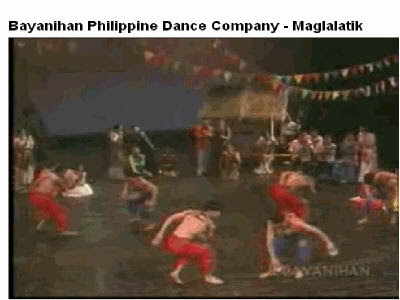
The dance is about a fight for the latik or coconut meat during the Spanish era.
videocredit: Masterscribble
Today, this dance is performed in honor of the town's patron saint, San Isidro Labrador. All dancers are male and are naked to the waist except for the coconut shells attached to their chests, backs and hips. The Muslim dancers wear red trousers while the Christian dancers wear blue. There are also coconut shells on their thighs and knees. As they dance, they touch these shells with their coconut shells on their hands.
Technorati tags:
Philippine Folk Dance,,tinikling,singkil,itik,binasuan,pandango sa ilaw
Friday, July 20, 2007
Sublian

Sublian
This is a ritual dance that originated from Bauan, Batangas in Luzon, Philippines. The word sublian comes from the word subsub which means falling head on and bali which means broken. The word describes the dancers who pretend to be lame and crooked throughout the dance as a sign of worship to the town's Church icon, the Holy Cross during its fiesta celebration.
Technorati tags:
Philippine Folk Dance,,tinikling,singkil,itik,binasuan,pandango sa ilaw
Thursday, July 19, 2007
Tinikling
Tinikling is a Filipino folk dance.
The dance originated in Leyte as an imitation of the legendarily fast and graceful movements of the tikling birds as they dodged bamboo traps set by rice farmers.
An alternative explanation says that the dance originated from Spanish colonization, where field workers who worked too slowly were punished by having to stand in place and jump over two bamboo poles clapped together against their ankles; it is said that from a distance the jumping workers looked like tikling birds.[1] Often, this dance is mistakenly coined as the national dance of the Philippines instead of the Cariñosa.
The dance consists of at least one team of two people hitting two parallel bamboo poles on the ground, raising them slightly, then clapping the poles against each other near the ground with a rhythm. Meanwhile, at least one dancer hops over and around the clashing poles in a manner not entirely unlike jump roping. Usually the dancers use certain rhythms or steps.
source: wikipedia
Technorati tags:
Philippine Folk Dance,,tinikling,singkil,itik,binasuan,pandango sa ilaw
Wednesday, July 18, 2007
Talumpati ni Noli De Castro sa Pagdiriwang ng Linggo ng Wika

QUALITY EDUCATION AND JOB OPPORTUNITIES FOR ALL
In celebration of the Buwan Ng Wika at the Department of Education, Ortigas, Pasig City, 8:00 a.m., 18 July 2003
"Maganda at makabuluhang umaga sa ating lahat! Sana ay nagising na ng kape ang bawat ugat sa inyong katawan at kayo ay nakapag-unat na upang buong handang harapin ang trabaho sa linggong darating.
Kagalang-galang na Kalihim Edilberto De Jesus, mga opisyales at kawani ng Kagawaran ng Edukasyon, malaking karangalan para sa inyong Kabayan ang makadalo sa inyong taonang pagdiriwang ng Buwan ng Wikang Pambansa.
Masasabi kong malaking karangalan na kayo ay aking makaharap sa umagang ito dahil alam nating lahat na ang Kagawaran ng Edukasyon ang pinakamahalagang sangay ng ating pamahalaan dahil kayo ang nagsisilbing pag-asa at tulay sa magandang bukas para sa mga estudyanteng Pilipino. Saludo ako sa inyong dedikasyon sa inyong trabaho at sa inyong serbisyo sa ating bansa.
Isang magandang programa ng DepEd ang kasalukuyang paggunita sa kahalagahang ng Wikang Pambansa. Bilang isa sa mga nangunguna sa pagpapatibay sa wikang pambansa, ako ay nalulungkot na sa pagdaan ng humigit pitongpu’t-limang taon mula ng ideklara ang Tagalog, na ngayon ay Filipino, bilang pambansang wika ni Presidente Manuel Luis Quezon, ay marami pa rin sa ating mga kababayan, lalo na ang mga prominenteng opisyal ng gubyerno, ang mas nanaisin pang gamitin ng banyagang salita sa loob at labas ng tahanan,….. at kung minsa’y ititinatatwa pa ang salitang sariling atin.
Gayunpaman, naniniwala ako na sa pangunguna ng DepEd, magdaan man ang mahabang panahon ay patuloy pa ring lalaganap ang salitang Filipino at sa pamamagitan ng mga programang gaya ng Buwan ng Wikang Pambansa na ating pinagdiriwang ngayon, ay mamahalin din ng mga darating na henerasyon ang wikang Filipino.
Sa kinalakihan kong lalawigan ng Oriental Mindoro ay likas at laganap ang pagsalita ng wikang Filipino. Sa bahay, kalye, opisina o sa paaralan ay Filipino ang aming salita. Naaalala ko noong aking kabataan ay malimit akong pina-aalalahanan ng aking Nanay na mahalin ang ating sariling wika dahil ang magigiting na mga bayani ng ating lahi, na kinabibilanagn nina Jose Rizal, Andres Bonifacio, at Manuel Quezon, ay nabuhay at namatay na tinataguyod ang salitang ito.
Sa tulong at gabay ng aking ina ay maaga akong namulat sa kahalagahan ng ating sariling wika. Kung kaya’t maaga akong nanindigan na sa ano mang larangan o propesyon ang aking pasukin ay bibigyan ko ng prioridad ang pag-gamit ng Filipino. Nakakalungkot lamang na sa panahon ngayon ay binabatikos at kinukutya ang mga kagaya naming mas pinahahalagahan ang salitang Filipino.
Gayunpaman, hindi ako natitinag. Taas noo kong itataguyod ang ating sariling wika dahil ito ang simbolo ng ating pagka-Pilipino. Gaya nga ng katagang iniwan ni Gat Jose Rizal: “Ang taong hindi marunong magmahal sa sariling wika ay masahol pa ang amoy sa malansang isda”.
Ang sabi naman ni Kabayan: “Ang hindi pagtangkilik ng sariling wika ay paglapastangan sa Inang Bayan.” At tayong mga nasa gubyerno ang dapat manguna sa paggamit ng wikang Filipino bilang magandang halimbawa sa ating mga kababayan.
Sa pagdiriwang natin ng Buwan ng Wika, nararapat lamang na ating balikan ang kasaysayan ng pagdedeklara ng Filipino bilang pambansang wika. Ako ho ay naniniwala na upang lalo nating pahalagahan ang ating wika ay nararapat lamang na alamin natin ang kasaysayan nito.
Nakasaad sa ating unang Saligang-Batas, na na-ratipikahan noong 1935, na ang Tagalog ang opisyal na lenguahe ng ating pamahalaan. Sangayon sa nasasaad sa Saligang Batas, noong November 13, 1937, inaprubahan ng unang National Assembly ang batas na nagbubuo ng National Language Institute o NLI. Ang NLI ay naatasang pag-aralan ang mga katutubong wika upang makatukoy ng isang lenguahe na nararapat na kumatawan sa lahat ng mga salita sa iba’t ibang rehiyon. Matapos ang paga-aral ay napagpasyahan ng pamahalaan ang Tagalog bilang nararapat na pambansang wika.
Bilang epekto ng pagaaral na ito, noong December 31, 1946 ay dineklara ni Pangulong Manuel L. Quezon, na tubong Baler, Tayabas, ang Tagalog bilang Pambansang Wika ng Pilipinas.
Makaraang ideklara ang independensiya ng Pilipinas mula sa mga Amerikanong mananakop noong July 4, 1946, ay isinabatas naman ng National Assembly ang Commonwealth Act No. 570. Sinasaad dito ang pagbilang sa Tagalog bilang isa sa tatlong opisyal na wika ng pamahalaang Pilipinas, kabilang sa Espanol at Ingles.
At dahil i-ilang probinsya lamang sa Luzon ang gumagamit ng salitang Tagalog, hindi naging madali para sa mga kababayan natin sa hilaga at timog Luzon, Visayas at Mindanao na tanggapin ang pagkakahirang sa salitang Tagalog bilang pambansang wika. Upang malutas ang reklamo at batikos ng mga gumagamit ng ibang katutubong-salita, ang Tagalog ay pinalitan ng pangalang Pilipino noong 1959.
Sa loob ng Konstitusyon ng 1973, ang Pilipino ay ginawang isa lamang sa dalawang opisyal ng salita ng ating bansa, ang isa pa ay ang wikang Ingles. Noong ding dekada setenta ay sinimulan ng National Board of Education ang paggamit ng bilingual method sa pagtuturo sa lahat ng antas ng edukasyon.
Sa ilalim ng Konstitusyon ng 1987, muling nabigyan ng halaga ang salitang Filipino. Datapwat Filipino at Ingles pa rin ang opisyal na wika sa ating saligang-batas, naglagay ang 1986 Constitutional Convention ng isang probisyon na nagaatas sa ating Kongreso na pagaralan at magbuo ng isang tunay na pambansang wika na tatawaging Filipino na kakatawan sa lahat ng mga katutubong wika at maging wikang banyaga na malaki rin ang impluwensya sa paghubog ng ating kalinangan.
Labing-anim na taon mula ng maipagtibay ang kasalukuyang Saligang-Batas, malayo na ang narating ng ating pambansang wika. Malaki na ang itinaas ng kamalayan ng bawat mag-aaral na Pilipino sa wikang Filipino. At yan ay pinagpapasalamat natin sa lahat kayong mga nasa Kagawarang ito.
Sa pagdiriwang natin ng Buwan ng Wika, huwag nating kaligtaan na ang Pambansang Wika ay dapat magsilbing dagta na makapag-bubuo sa ating mga Pilipino saan man dako ng mundo tayo makarating. Hayaan ninyong tapusin ko ang aking talumpati sa isang hangarin na sana ay mabigyang katuparan ang pangarap nina Gat Jose Rizal at dating Pangulong Quezon na isang araw ay mangingibabaw ang salitang Filipino sa pang-araw-araw na buhay ng ating mga kababayan.
Maraming Salamat Po! Mabuhay ang Wikang Filipino!
talumpati,Linggo ng Wika,Noli de Castro,Tagalog speeches
Tuesday, July 17, 2007
La Jota Manileña
La Jota Manileña
This is a dance named after Manila, the old capital of the Philippines. The dance is an adaptation of the Castilian Jota where dancers where where dancers use bamboo castanets and clack them to provide music. The costumes are inspired by Spanish culture.
Technorati tags:
Philippine Folk Dance,,tinikling,singkil,itik,binasuan,pandango sa ilaw
Monday, July 16, 2007
Itik-itik

videocredit: Masterscribble
Itik-itik
The dance originated from Surigao del Norte, Mindanao, Philippines.
According to the story, a young woman named Kanang (short for Cayetana) was the best dancer in that province. At one baptismal celebration, she introduced new steps which were improvisations of the dance Sibay. She imitated the movements of the ducks or itik. Because of its unusual steps and fascinating interpretation, the audience began imitating her.
Technorati tags:
Philippine Folk Dance,,tinikling,singkil,itik,binasuan,pandango sa ilaw
Sunday, July 15, 2007
Singkil
Singkil (or Sayao sa Kasingkil) is a famous Philippine dance of the Maguindanao people, but was popularized by the nearby Maranao peoples of Lake Lanao and later the Bayanihan Philippine National Folk Dance Company.

videocredit: Masterscribble
Also known as the Princess Dance or the Royal Maranao Fan Dance, the dance is based on the Maranao interpretation of the ancient Indian epic, the Ramayana: the Darangen. The Singkil narrates a scene in which Sita (Putri Gandingan) escapes her abductor, the demon king Ravana and is lost in the forests of Alangka, thereupon being found by her husband, Prince Rama. Interesting to note is that in the original Ramayana epic, Rama selects Hanuman, the Hindu monkey-god, to find Sita on his behalf; the fact that in the Singkil it is Rama (Rajah Bantugan) who finds her suggests a modification of the original Hindu narration in order to agree with monotheistic Islamic ideology.
Kasingkil refers to the art of moving one’s feet in and out of two clicking bamboo poles in imitation of Putri Gandingan who gracefully avoided the falling trees brought about by an earthquake.
Performers would therefore gracefully step in and out of bamboo poles, arranged in crisscross fashion while manipulating either fans or simply their bare hands.Played at celebrations and festivals, traditionally the dance was performed by a girl of royal blood intend on advertising herself to would-be-suitors for her future marriage.
The dance is said to have been named after either the leg bracelets or anklets of silver, nickel or brass with chiming bells of the same name or the act of voluntarily or accidentally entangling on one’s feet in either vines or tall grass.
source: Wikipedia
Technorati tags:
Philippine Folk Dance,,tinikling,singkil,itik,binasuan,pandango sa ilaw
Subscribe to:
Posts (Atom)

 Posts


