
Chotis
videocredit
(CHOH-tees)
Chotis (or "Shotis") was one of the ballroom dances introduced by early European settlers. This dance, from Camarines Sur, has been adapted by the Bicolano people and is characterized by a brush-step-hop movement.
back to Philippines Folk Dances
Technorati tags:
Philippine Folk Dance History,Classification of Philippine Folk Dances,
Philippine Folk Dance,tinikling,singkil,itik,binasuan,pandango sa ilaw,sayaw sa bangko
Showing posts with label Folk Dance from Luzon. Show all posts
Showing posts with label Folk Dance from Luzon. Show all posts
Sunday, December 9, 2007


Sunday, December 2, 2007
BINDIAN
Bindian
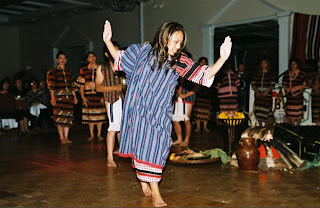
Bindian originated from Northern Luzon. It also falls under Mountain and Igorot Dance.
BIHN-deeh-ahn)
The Ibaloy who inhabit the southernmost mountain regions in Northern Luzon perform victory dances to extol the bravery of the warriors of yesterday. In this version from the barrio of Kabayan, hand movements are downward, suggesting the people's affinity with the earth. The basic step consists of a stamp by the left foot and a light, forward movement by the right. Instrumentalists lead the line, followed by male dancers, while the female dancers bring in the rear.
Technorati tags:
Philippine Folk Dance,,tinikling,singkil,itik,binasuan,pandango sa ilaw,sayaw sa bangko,carinosa,kalapati,kuratsa,kuratsa,Types of Philippine Folk Dances
Bindian originated from Northern Luzon. It also falls under Mountain and Igorot Dance.

BIHN-deeh-ahn)
The Ibaloy who inhabit the southernmost mountain regions in Northern Luzon perform victory dances to extol the bravery of the warriors of yesterday. In this version from the barrio of Kabayan, hand movements are downward, suggesting the people's affinity with the earth. The basic step consists of a stamp by the left foot and a light, forward movement by the right. Instrumentalists lead the line, followed by male dancers, while the female dancers bring in the rear.
Technorati tags:
Philippine Folk Dance,,tinikling,singkil,itik,binasuan,pandango sa ilaw,sayaw sa bangko,carinosa,kalapati,kuratsa,kuratsa,Types of Philippine Folk Dances
Monday, November 26, 2007
BANGA DANCE
KALINGA BANGA DANCE

(bahng-AH)
ThE BANGA dance is classified under Mountain-Igorot dances.This is from Kalinga, LUZON. The dance shows the Igorot maidens go to the river and prepare for a marriage ceremony. They display not only their grace and agility, but also their stamina and strength as they go about their daily task of fetching water and balancing the banga, claypots full of water, on their heads.

(bahng-AH)
ThE BANGA dance is classified under Mountain-Igorot dances.This is from Kalinga, LUZON. The dance shows the Igorot maidens go to the river and prepare for a marriage ceremony. They display not only their grace and agility, but also their stamina and strength as they go about their daily task of fetching water and balancing the banga, claypots full of water, on their heads.
Apayao Courtship Dance-Mountain-Igorot Dances

Th APAYAO COURTSHIP DANCE comes from the northernmost section of the Mountain provinces in Luzon. Classified under Mountain-Igorot Dance, the couple raise and wave their arms and hands like the wings of a bird in flight, and the ceremonial blanket worn by the woman is lightly wrapped around her. The man's movements resemble those of a fighting cock in the preening, strutting, and flying-off-the-ground gestures.
photocredit: Bibak
Philippine Folk Dance,,tinikling,singkil,itik,binasuan,pandango sa ilaw,sayaw sa bangko,Apayao courtship dance,carinosa
Sunday, November 25, 2007
PATTONG OR BONTOC WAR DANCE
PATTONG OR BONTOC WAR DANCE

PAH-tohng)
PATTONG OR BONTOC WAR DANCE is classified under Mountain-Igorot dances. It is a war dance that originated from Luzon Known also as the Bontoc War Dance, Pattong is part of the headhunting and war ceremonials inciting feelings of strength and courage as the warriors prepare to stalk their enemy. In Central Bontoc, the dance is also performed in February, March, and April, to implore the god Lumawig to send rain, similar in purpose to that of the rain-calling ceremony of Native American tribes. Much of the movements are improvised; two camps of warriors are usually featured pursuing each other, culminating in a melee where a fighter from one tribe kills one of his opponents.
back to Philippines Folk Dances
Technorati tags:
Philippine Folk Dance History,Classification of Philippine Folk Dances,
Philippine Folk Dance,tinikling,singkil,itik,binasuan,pandango sa ilaw,sayaw sa bangko

PAH-tohng)
PATTONG OR BONTOC WAR DANCE is classified under Mountain-Igorot dances. It is a war dance that originated from Luzon Known also as the Bontoc War Dance, Pattong is part of the headhunting and war ceremonials inciting feelings of strength and courage as the warriors prepare to stalk their enemy. In Central Bontoc, the dance is also performed in February, March, and April, to implore the god Lumawig to send rain, similar in purpose to that of the rain-calling ceremony of Native American tribes. Much of the movements are improvised; two camps of warriors are usually featured pursuing each other, culminating in a melee where a fighter from one tribe kills one of his opponents.
back to Philippines Folk Dances
Technorati tags:
Philippine Folk Dance History,Classification of Philippine Folk Dances,
Philippine Folk Dance,tinikling,singkil,itik,binasuan,pandango sa ilaw,sayaw sa bangko
Friday, November 23, 2007
BINDIAN
BINDIAN is classifeid under MOUNTAIN-IGOROT DANCES and originated in LUZON.

BIHN-deeh-ahn)
Bindian is a victory dance. The Ibaloys who inhabit the southernmost mountain regions in Northern Luzon perform victory dances to extol the bravery of the warriors of yesterday. In this version from the barrio of Kabayan, hand movements are downward, suggesting the people's affinity with the earth. The basic step consists of a stamp by the left foot and a light, forward movement by the right. Instrumentalists lead the line, followed by male dancers, while the female dancers bring in the rear.

BIHN-deeh-ahn)
Bindian is a victory dance. The Ibaloys who inhabit the southernmost mountain regions in Northern Luzon perform victory dances to extol the bravery of the warriors of yesterday. In this version from the barrio of Kabayan, hand movements are downward, suggesting the people's affinity with the earth. The basic step consists of a stamp by the left foot and a light, forward movement by the right. Instrumentalists lead the line, followed by male dancers, while the female dancers bring in the rear.
Monday, November 5, 2007
Palu-palo from Laguna
In Laguna, the village labanderas, or washerwomen, spend a relatively calm day doing their laundry when tsismis, or gossip, among them gets out of hand, and drama ensues. Through fighting with their palos (laundry paddles) to resolve their disputes, their dance comes to life.
Philippine Folk Dance,,tinikling,singkil,itik,binasuan,pandango sa ilaw,sayaw sa bangko,carinosa
Philippine Folk Dance,,tinikling,singkil,itik,binasuan,pandango sa ilaw,sayaw sa bangko,carinosa
Palu-Palo Dance from Batanes
One is from Ivatan, Batanes
Palu-palo, is a war dance that shows how the community joins forces as one to defend themselves. It is a dance showing how the Ivatans defended themselves against the Christian intruders and how they learned to accept Christianity and live a virtuous life. The dance was a simple one performed by men who wore simple flesh-colored garments. The tapping of wooden sticks as background music to the dance produced an echoing sound as the Ivatans reenacted their battle with the Christian invaders.
The steps are just like sakuting and other stick dances like in this video.
Philippine Folk Dance,,tinikling,singkil,itik,binasuan,pandango sa ilaw,sayaw sa bangko,carinosa
Palu-palo, is a war dance that shows how the community joins forces as one to defend themselves. It is a dance showing how the Ivatans defended themselves against the Christian intruders and how they learned to accept Christianity and live a virtuous life. The dance was a simple one performed by men who wore simple flesh-colored garments. The tapping of wooden sticks as background music to the dance produced an echoing sound as the Ivatans reenacted their battle with the Christian invaders.
The steps are just like sakuting and other stick dances like in this video.
Philippine Folk Dance,,tinikling,singkil,itik,binasuan,pandango sa ilaw,sayaw sa bangko,carinosa
Monday, July 30, 2007
Carinosa
Carinosa
Cariñosa (IPA: [ˌkariˈɲosa]) is a flirtatious Philippine group dance in the Maria Clara suite of Philippine folk dances where the fan or handkerchief plays an instrumental roll as it places the couple in a hard-to-get romance scenario. Despite popular belief, Cariñosa has always been the national dance of the Philippines, whereas the Tinikling is just a worldwide favorite.
source: wikipedia
videocredit: cfilipiniana
Technorati tags:
Philippine Folk Dance,,tinikling,singkil,itik,binasuan,pandango sa ilaw,sayaw sa bangko,carinosa
Cariñosa (IPA: [ˌkariˈɲosa]) is a flirtatious Philippine group dance in the Maria Clara suite of Philippine folk dances where the fan or handkerchief plays an instrumental roll as it places the couple in a hard-to-get romance scenario. Despite popular belief, Cariñosa has always been the national dance of the Philippines, whereas the Tinikling is just a worldwide favorite.
source: wikipedia
videocredit: cfilipiniana
Technorati tags:
Philippine Folk Dance,,tinikling,singkil,itik,binasuan,pandango sa ilaw,sayaw sa bangko,carinosa
Sunday, July 22, 2007
Kalapati
Kalapati
The dance Kalapati originated from from Cabugao, Ilocos Sur province. It symbolizes peace and is represented by imitating the movements of a graceful dove. It portrays the typical traits of the Ilokanos: simplicity, naturalness, and shyness.
videocredit:xquietdreamerx
Technorati tags:
Philippine Folk Dance,,tinikling,singkil,itik,binasuan,pandango sa ilaw,sayaw sa bangko,carinosa,kalapati
The dance Kalapati originated from from Cabugao, Ilocos Sur province. It symbolizes peace and is represented by imitating the movements of a graceful dove. It portrays the typical traits of the Ilokanos: simplicity, naturalness, and shyness.
videocredit:xquietdreamerx
Technorati tags:
Philippine Folk Dance,,tinikling,singkil,itik,binasuan,pandango sa ilaw,sayaw sa bangko,carinosa,kalapati
Saturday, July 21, 2007
Aray
Aray
A dance whose words are sung in "Chabacano-ermitense," a hybrid of Spanish that was only spoken in the Ermita district before the turn of the century and today is extinct. The dance itself is a flirtatious one that involves graceful use of the pañuelo, or shawl, and tambourines. Aray means "ouch" in Tagalog.

Technorati tags:
Philippine Folk Dance,,tinikling,singkil,itik,binasuan,pandango sa ilaw,sayaw sa bangko
A dance whose words are sung in "Chabacano-ermitense," a hybrid of Spanish that was only spoken in the Ermita district before the turn of the century and today is extinct. The dance itself is a flirtatious one that involves graceful use of the pañuelo, or shawl, and tambourines. Aray means "ouch" in Tagalog.

Technorati tags:
Philippine Folk Dance,,tinikling,singkil,itik,binasuan,pandango sa ilaw,sayaw sa bangko
Sayaw sa Bangko
Sayaw Sa Bangko
This dance is native to the barrio of Pangapisan, Lingayen, Pangasinan, and demands skill from its performers who must dance on top of a bench roughly six inches wide.

videocredit: the realdeal
Technorati tags:
Philippine Folk Dance,,tinikling,singkil,itik,binasuan,pandango sa ilaw,sayaw sa bangko
This dance is native to the barrio of Pangapisan, Lingayen, Pangasinan, and demands skill from its performers who must dance on top of a bench roughly six inches wide.

videocredit: the realdeal
Technorati tags:
Philippine Folk Dance,,tinikling,singkil,itik,binasuan,pandango sa ilaw,sayaw sa bangko
Maglalatik
Maglalatik- This a mock war dance between the Muslims and the Christians that originated from Binan, Laguna, Philippines.
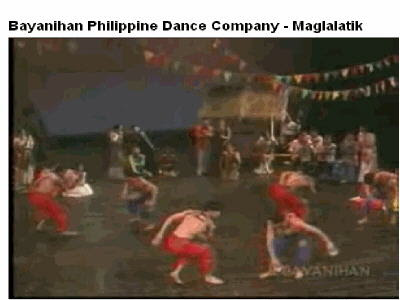
The dance is about a fight for the latik or coconut meat during the Spanish era.
videocredit: Masterscribble
Today, this dance is performed in honor of the town's patron saint, San Isidro Labrador. All dancers are male and are naked to the waist except for the coconut shells attached to their chests, backs and hips. The Muslim dancers wear red trousers while the Christian dancers wear blue. There are also coconut shells on their thighs and knees. As they dance, they touch these shells with their coconut shells on their hands.
Technorati tags:
Philippine Folk Dance,,tinikling,singkil,itik,binasuan,pandango sa ilaw

The dance is about a fight for the latik or coconut meat during the Spanish era.
videocredit: Masterscribble
Today, this dance is performed in honor of the town's patron saint, San Isidro Labrador. All dancers are male and are naked to the waist except for the coconut shells attached to their chests, backs and hips. The Muslim dancers wear red trousers while the Christian dancers wear blue. There are also coconut shells on their thighs and knees. As they dance, they touch these shells with their coconut shells on their hands.
Technorati tags:
Philippine Folk Dance,,tinikling,singkil,itik,binasuan,pandango sa ilaw
Friday, July 20, 2007
Sublian

Sublian
This is a ritual dance that originated from Bauan, Batangas in Luzon, Philippines. The word sublian comes from the word subsub which means falling head on and bali which means broken. The word describes the dancers who pretend to be lame and crooked throughout the dance as a sign of worship to the town's Church icon, the Holy Cross during its fiesta celebration.
Technorati tags:
Philippine Folk Dance,,tinikling,singkil,itik,binasuan,pandango sa ilaw
Tuesday, July 17, 2007
La Jota Manileña
La Jota Manileña
This is a dance named after Manila, the old capital of the Philippines. The dance is an adaptation of the Castilian Jota where dancers where where dancers use bamboo castanets and clack them to provide music. The costumes are inspired by Spanish culture.
Technorati tags:
Philippine Folk Dance,,tinikling,singkil,itik,binasuan,pandango sa ilaw
This is a dance named after Manila, the old capital of the Philippines. The dance is an adaptation of the Castilian Jota where dancers where where dancers use bamboo castanets and clack them to provide music. The costumes are inspired by Spanish culture.
Technorati tags:
Philippine Folk Dance,,tinikling,singkil,itik,binasuan,pandango sa ilaw
Saturday, July 14, 2007
PANDANGGO SA SAMBALILO
PANDANGGO SA SAMBALILO
This is a very interesting courtship dance from Camiling, Tarlac province involving a hat. The boy tries to impress the girl by picking up the hat from the
floor, by his head, unaided by hands.
This is a very interesting courtship dance from Camiling, Tarlac province involving a hat. The boy tries to impress the girl by picking up the hat from the
floor, by his head, unaided by hands.
Subscribe to:
Posts (Atom)

 Posts
Posts


