
The Udol is a ceremonial dance performed by the Tagacaulo and the B'laan people of southern Davao. It presents a tale of death and revenge. The dance begins with three women entering with votive torches, mourning the death of a relative. Following them are men playing a long wooden musical instrument called the udol [also called edel or gudol]. The women express their grief eloquently with such actions as wielding spears and pounding the udol in anger in a rhythm that contrasts with the steady beat of the music. Then a male priest dances and invokes the spirits to guide the soul of the deceased. Finally, two spear-bearing warriors arrive and dance wildly in a circle before leaving for the woods, apparently to take revenge by securing their enemies' heads.
source:
Showing posts with label Folk Dance from Mindanao. Show all posts
Showing posts with label Folk Dance from Mindanao. Show all posts
Tuesday, August 31, 2010


Monday, September 1, 2008
KARASAGUYON-Folk Dance from Mindanao
KARASAGUYON
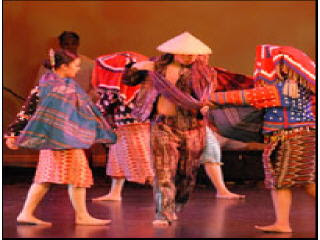
The dance is classified under Tribal dance. it originated from Lake Sebu, South Cotabato. "Karasaguyon" of the T'boli portrays a polygamous male in the process of picking his next wife from among four sisters vying for his attention. The jingling of beads and brass bells around their waists and ankles provide musical accompaniment.
source: Hiyas
back to Philippines Folk Dances
Technorati tags:
Philippine Folk Dance History,Classification of Philippine Folk Dances,
Philippine Folk Dance,tinikling,singkil,itik,binasuan,pandango sa ilaw,sayaw sa bangko

The dance is classified under Tribal dance. it originated from Lake Sebu, South Cotabato. "Karasaguyon" of the T'boli portrays a polygamous male in the process of picking his next wife from among four sisters vying for his attention. The jingling of beads and brass bells around their waists and ankles provide musical accompaniment.
source: Hiyas
back to Philippines Folk Dances
Technorati tags:
Philippine Folk Dance History,Classification of Philippine Folk Dances,
Philippine Folk Dance,tinikling,singkil,itik,binasuan,pandango sa ilaw,sayaw sa bangko
Sunday, August 31, 2008
ASIK-MindanaoFolk Dance
ASIK
(ah-SIHK)
A solo slave dance performed by the umbrella-bearing attendant to win the favor of her sultan master. Asik usually precedes a performance of Singkil.
videocredit
back to Philippines Folk Dances
Technorati tags:
Philippine Folk Dance History,Classification of Philippine Folk Dances,
Philippine Folk Dance,tinikling,singkil,itik,binasuan,pandango sa ilaw,sayaw sa bangko
(ah-SIHK)
A solo slave dance performed by the umbrella-bearing attendant to win the favor of her sultan master. Asik usually precedes a performance of Singkil.
videocredit
back to Philippines Folk Dances
Technorati tags:
Philippine Folk Dance History,Classification of Philippine Folk Dances,
Philippine Folk Dance,tinikling,singkil,itik,binasuan,pandango sa ilaw,sayaw sa bangko
Saturday, August 30, 2008
UDOL-Folk Dance from Mindanao
UDOL Dance
videocredit
Udol Dance
(ooh-DOHL)
This dance is classified under Tribal dances. It originated from the Tagakaulo tribe
of southern Davao.This is a ceremonial dance which portrays death and revenge. It opens with three women walking in with votive candles, mourning the loss of a relative. They are followed by men playing the udol, a long wooden musical instrument. The woman make eloquent gestures of tenderness and despair such as wielding a spear and pounding the udol in anger, countering the steady rhythms of the musicians. A male priest then dances, begging the spirits to guide the soul of the deceased. Finally, two warriors enter, spears in hand, performing a frenzied dance in a circle, then disappearing off stage "to the woods," apparently to secure the heads of their enemies.
back to Philippines Folk Dances
Technorati tags:
Philippine Folk Dance History,Classification of Philippine Folk Dances,
Philippine Folk Dance,tinikling,singkil,itik,binasuan,pandango sa ilaw,sayaw sa bangko
videocredit
Udol Dance
(ooh-DOHL)
This dance is classified under Tribal dances. It originated from the Tagakaulo tribe
of southern Davao.This is a ceremonial dance which portrays death and revenge. It opens with three women walking in with votive candles, mourning the loss of a relative. They are followed by men playing the udol, a long wooden musical instrument. The woman make eloquent gestures of tenderness and despair such as wielding a spear and pounding the udol in anger, countering the steady rhythms of the musicians. A male priest then dances, begging the spirits to guide the soul of the deceased. Finally, two warriors enter, spears in hand, performing a frenzied dance in a circle, then disappearing off stage "to the woods," apparently to secure the heads of their enemies.
back to Philippines Folk Dances
Technorati tags:
Philippine Folk Dance History,Classification of Philippine Folk Dances,
Philippine Folk Dance,tinikling,singkil,itik,binasuan,pandango sa ilaw,sayaw sa bangko
Friday, August 29, 2008
MAGLANGKA-Folk Dance from Mindanao
MAGLANGKA
videocredit
Maglangka
This dance which originated from Jolo, Sulu is classified under Muslim Dance. Literally meaning "to dance," the maglangka is used to mold the adolescent girls into ladies of good breeding and accomplished dancing skills. The girls are strictly taught to gracefully execute movements imitating birds in flight, fish swimming in the sea, or branches swaying in the air while remaining in the confines of a square cloth. these movements require intense concentration and innate style as the ladies express emotions and entertain guests.
back to Philippines Folk Dances
Technorati tags:
Philippine Folk Dance History,Classification of Philippine Folk Dances,
Philippine Folk Dance,tinikling,singkil,itik,binasuan,pandango sa ilaw,sayaw sa bangko
videocredit
Maglangka
This dance which originated from Jolo, Sulu is classified under Muslim Dance. Literally meaning "to dance," the maglangka is used to mold the adolescent girls into ladies of good breeding and accomplished dancing skills. The girls are strictly taught to gracefully execute movements imitating birds in flight, fish swimming in the sea, or branches swaying in the air while remaining in the confines of a square cloth. these movements require intense concentration and innate style as the ladies express emotions and entertain guests.
back to Philippines Folk Dances
Technorati tags:
Philippine Folk Dance History,Classification of Philippine Folk Dances,
Philippine Folk Dance,tinikling,singkil,itik,binasuan,pandango sa ilaw,sayaw sa bangko
Thursday, August 28, 2008
PANGALAY-Folk Dance from Mindanao
PANGALAY
(pahng-AH-lahy)
This dance is classified under Muslim/Moro dance. It is a popular festival dance in Sulu, during wedding celebrations among the affluent families. They may last for several days or even weeks depending on the financial status and agreement of both families. Dancers perform this dance to the music of the kulintangan, gabbang, and agongs during the wedding feast.
videocredit
back to Philippines Folk Dances
Technorati tags:
Philippine Folk Dance History,Classification of Philippine Folk Dances,
Philippine Folk Dance,tinikling,singkil,itik,binasuan,pandango sa ilaw,sayaw sa bangko
(pahng-AH-lahy)
This dance is classified under Muslim/Moro dance. It is a popular festival dance in Sulu, during wedding celebrations among the affluent families. They may last for several days or even weeks depending on the financial status and agreement of both families. Dancers perform this dance to the music of the kulintangan, gabbang, and agongs during the wedding feast.
videocredit
back to Philippines Folk Dances
Technorati tags:
Philippine Folk Dance History,Classification of Philippine Folk Dances,
Philippine Folk Dance,tinikling,singkil,itik,binasuan,pandango sa ilaw,sayaw sa bangko
Tuesday, July 31, 2007
Sagayan
FOLK DANCE FROM MINDANAO-PHILIPPINE FOLK DANCE
SAGAYAN is a Philippine war dance performed by both the Maguindanao and Maranao depicting in dramatic fashion the steps their hero, Prince Bantugan, took upon wearing his armaments, the war he fought in and his subsequent victory afterwards. Performers, depicting fierce warriors would carry shield with shell noisemakers in one hand and double-bladed sword in the other attempting rolling movements to defend their master.
Source: wikipedia
videocredit: kfgcatanauan
Technorati tags:
Philippine Folk Dance,,tinikling,singkil,itik,binasuan,pandango sa ilaw,sayaw sa bangko,carinosa,kalapati,kuratsa,dugso
SAGAYAN is a Philippine war dance performed by both the Maguindanao and Maranao depicting in dramatic fashion the steps their hero, Prince Bantugan, took upon wearing his armaments, the war he fought in and his subsequent victory afterwards. Performers, depicting fierce warriors would carry shield with shell noisemakers in one hand and double-bladed sword in the other attempting rolling movements to defend their master.
Source: wikipedia
videocredit: kfgcatanauan
Technorati tags:
Philippine Folk Dance,,tinikling,singkil,itik,binasuan,pandango sa ilaw,sayaw sa bangko,carinosa,kalapati,kuratsa,dugso
Tuesday, July 24, 2007
Dugso
The dance must have originated from Bukidnon, northeastern Mindanao since they are performed as an entertainment for the deities in fiestas organized for them.It was originally thought that this dance was performed only during harvest time or upon the birth of a male heir. Women would wear colorful feathered head dresses, plaid costumes and anklets. They would step rhythmically around a bamboo arch decorated with newly-gathered palay (rice stalks) and corn, and their movements are emphasized by the tinkling sounds from the anklets.
videocredit: Kfgcatanauan
Technorati tags:
Philippine Folk Dance,,tinikling,singkil,itik,binasuan,pandango sa ilaw,sayaw sa bangko,carinosa,kalapati,kuratsa,dugso
videocredit: Kfgcatanauan
Technorati tags:
Philippine Folk Dance,,tinikling,singkil,itik,binasuan,pandango sa ilaw,sayaw sa bangko,carinosa,kalapati,kuratsa,dugso
Saturday, July 21, 2007
Kappa
This is also known as Sambi sa Malong. This Maranao dance shows the many ways of donning the malong, a tubular circle of cloth used as a skirt, shawl, or mantle.

Technorati tags:
Philippine Folk Dance,,tinikling,singkil,itik,binasuan,pandango sa ilaw,sayaw sa bangko

Technorati tags:
Philippine Folk Dance,,tinikling,singkil,itik,binasuan,pandango sa ilaw,sayaw sa bangko
Monday, July 16, 2007
Itik-itik

videocredit: Masterscribble
Itik-itik
The dance originated from Surigao del Norte, Mindanao, Philippines.
According to the story, a young woman named Kanang (short for Cayetana) was the best dancer in that province. At one baptismal celebration, she introduced new steps which were improvisations of the dance Sibay. She imitated the movements of the ducks or itik. Because of its unusual steps and fascinating interpretation, the audience began imitating her.
Technorati tags:
Philippine Folk Dance,,tinikling,singkil,itik,binasuan,pandango sa ilaw
Sunday, July 15, 2007
Singkil
Singkil (or Sayao sa Kasingkil) is a famous Philippine dance of the Maguindanao people, but was popularized by the nearby Maranao peoples of Lake Lanao and later the Bayanihan Philippine National Folk Dance Company.

videocredit: Masterscribble
Also known as the Princess Dance or the Royal Maranao Fan Dance, the dance is based on the Maranao interpretation of the ancient Indian epic, the Ramayana: the Darangen. The Singkil narrates a scene in which Sita (Putri Gandingan) escapes her abductor, the demon king Ravana and is lost in the forests of Alangka, thereupon being found by her husband, Prince Rama. Interesting to note is that in the original Ramayana epic, Rama selects Hanuman, the Hindu monkey-god, to find Sita on his behalf; the fact that in the Singkil it is Rama (Rajah Bantugan) who finds her suggests a modification of the original Hindu narration in order to agree with monotheistic Islamic ideology.
Kasingkil refers to the art of moving one’s feet in and out of two clicking bamboo poles in imitation of Putri Gandingan who gracefully avoided the falling trees brought about by an earthquake.
Performers would therefore gracefully step in and out of bamboo poles, arranged in crisscross fashion while manipulating either fans or simply their bare hands.Played at celebrations and festivals, traditionally the dance was performed by a girl of royal blood intend on advertising herself to would-be-suitors for her future marriage.
The dance is said to have been named after either the leg bracelets or anklets of silver, nickel or brass with chiming bells of the same name or the act of voluntarily or accidentally entangling on one’s feet in either vines or tall grass.
source: Wikipedia
Technorati tags:
Philippine Folk Dance,,tinikling,singkil,itik,binasuan,pandango sa ilaw

videocredit: Masterscribble
Also known as the Princess Dance or the Royal Maranao Fan Dance, the dance is based on the Maranao interpretation of the ancient Indian epic, the Ramayana: the Darangen. The Singkil narrates a scene in which Sita (Putri Gandingan) escapes her abductor, the demon king Ravana and is lost in the forests of Alangka, thereupon being found by her husband, Prince Rama. Interesting to note is that in the original Ramayana epic, Rama selects Hanuman, the Hindu monkey-god, to find Sita on his behalf; the fact that in the Singkil it is Rama (Rajah Bantugan) who finds her suggests a modification of the original Hindu narration in order to agree with monotheistic Islamic ideology.
Kasingkil refers to the art of moving one’s feet in and out of two clicking bamboo poles in imitation of Putri Gandingan who gracefully avoided the falling trees brought about by an earthquake.
Performers would therefore gracefully step in and out of bamboo poles, arranged in crisscross fashion while manipulating either fans or simply their bare hands.Played at celebrations and festivals, traditionally the dance was performed by a girl of royal blood intend on advertising herself to would-be-suitors for her future marriage.
The dance is said to have been named after either the leg bracelets or anklets of silver, nickel or brass with chiming bells of the same name or the act of voluntarily or accidentally entangling on one’s feet in either vines or tall grass.
source: Wikipedia
Technorati tags:
Philippine Folk Dance,,tinikling,singkil,itik,binasuan,pandango sa ilaw
Saturday, January 20, 2007
MANOBO DANCE
MANOBO DANCE

The various dances among the Manobo entertain, educate, and propitiate the gods. Among the Agusanon are the sinundo/singangga, dance ritual to ward off epidemic busau; pangaliyag, courtship dance; pangasawa, marriage ritual; kinugsik-kugsik, squirrel dance. Those witnessed and described by Garvan (1931) in 1910 are the bathing dance, honey gathering dance, hair plucking dance, sexual dance, and dagger or sword dance.
The Agusanon and Umayamnon saet, Cotabato saut, and Western Bukidnon kedsaut is a war dance of one or two warriors, each holding either a war bolo or a spear with a bell attached to it, and a shield. In the kedsaut, the two dancers begin from opposite sides of the dance area, brandishing their shields and shaking their spears. First, they dance sideways, then they imitate a hawk in flight before they finally engage in mock combat, each hitting the other's shield with his spear and crashing shield against shield, "navel to navel" (Plenda 1989:139). Rhythmic music is provided by the bells attached to their spears.
An Arumanen Manobo verson of the war dance is the mangmangayan, with two bagani each brandishing a sundang (bolo) and a kampilan (sword). Every once in a while, in the course of the dance, they adjust their tangkulo (headgear). The Pulangi Manobo's version of the mangmangayan ends with a peace pact and a celebration dance which the women join. The datu/bai, acting as arbiter, places a kerchief on the ground and all the warriors place their weapons on it to signify peace and end of the hostilities.
Other Arumanen Manobo dances are the paningara (bee hunt), pegako (courtship dance), and pendaraka (woman's response to the courtship). The kinudlat ng sayao demonstrates the performer's ability to touch his shoulders with his toes. The penarangas-tangas and manmanaol are both hawk dances, which a bagani and a woman perform. In the manmanaol, the hawk catches its prey, represented by a kerchief on the floor.
The binanog (hawk dance) mimics a hawk sweeping down on its prey. The Cotabato Manobo version has a female dancer using a kerchief, which she drops and then picks up while using her hands and arms to imitate the hawk. The steps are simple hop-steps and slide-steps. She wears earrings that reach down to the shoulders and anklets. The beat is a slow 1-2-3-4. Among the Pulangi Manobo, the binanog is a component of the courtship dance. Two other Manobo dances imitating bird movements are the kakayamatan and the bubudsil (hornbill). These dances may be accompanied by gongs or zithers.
A vigorous courtship dance is the pig-agawan, which involves two women vying for the attention of one man. A bai and a datu try to settle the dispute between the two women. A slow walking dance exclusively for females of marriageable age is the takumbo, which signifies their availability for marriage. It is named after the musical instrument that accompanies their movements. Another woman's dance, also called takumbo, is performed by one woman who simultaneously dances and plucks the takumbo. She rests the takumbo on her waist while she holds it in her left hand.
In Kidapawan, Cotabato, girls dance around the mortar to the beat of their pestles as they pound rice. During harvest celebrations, the Tigwahanon have an occupational dance called inamong, in which men and women execute monkeylike steps as they step on rice stalks to separate the chaff from the grain. The bakbak is a children's comical dance; they hop and make noises by slapping their bodies while maintaining a squatting position throughout.
The agpanikop (fish hunt dance) of the Manobo of Matalam, north Cotabato, portrays a boy, torch and spear in hand, looking for edible frogs. A second boy joins him in the hunt after the initial mutual wariness is dispelled. The second boy is wounded and writhes in pain, the first boy fetches the womenfolk and the baylan. The dance turns into a healing dance ritual and the boy, fully recovered, joins the women and baylan in a thanksgiving dance.
The pangayam is a reenactment of a hunter in pursuit of a wild boar. He carries his lance and bolo and is accompanied by his dog, represented by a bottle to which a strip of red cloth is tied.
In the Umayamnon inanak-anak/bata-bata, a girl mimes a woman's chores. She pretends to take care of a baby, putting it to sleep, trying to stop its carrying, feeding it with milk. She goes to the fields to dig for camote, then washes and makes herself beautiful before a stream.
The Tigwahanon bangkakaw is a festival dance celebrating a war victory or a bountiful catch of fish from the river. The centerpiece is the bangkakaw (log), which the women beat with the ando (pestles) and the men, with lampus (rods) while doing some stunts over and under it. They provide the accompaniment for the dancing fisherfolk, who carry their catch in their bubo (fish traps) and liag (large basket with a headsling).
A thanksgiving ritual in Magpet, North Cotabato, is the binadbad, which begins with the men facing heavenwards as they address the gods. Atop (coconut palms) are suspended at the center of the dance area. Then women join the dance, their attention on the atop, which they gather one by one. They then vary their formations, each holding an atop. Another woman joins them, gathers all the atop from them, and returns these to the center.
Among the western Bukidnon Manobo, the dance of the healing ritual is the legudas. Women holding hands form a circle around the baylan, who chants to the busaw, requesting it to return to the deity that has sent it to cause the illness. The men then stand between the women in the circle. The women wear the saya (wraparound skirt), sinu-laman (embroidered blouse), embroidered belt, and tikes (knee band) with the seriyew (pewter bells). The rhythmic music is provided by the seriyew.
The haklaran, which has been observed among the Agusanon, Tigwahanon, and Umayamnon, is a healing ritual performed by a male and female baylan. A prelude to this is the ritual dressing of the male baylan in woman's skirt, usually a malong, for it is improper for a man to perform the haklaran in a man's attire. This dance is performed around the sankaw, an altar bearing the sacrificial offering of a pig's head.
The suyad-buya is the healing ritual dance in Magpet, North Cotabato. It dramatizes the process by which the baylan heals a sick boy as his mother and a group of young women watch. The women prepare the paraphernalia by bringing in a table on which they set four coconut shells containing burning incense. They also carry red ribbons meant to drive the evil spirits away. As they dance in the background, the baylan enters, dances around the patient and waves a white chicken overhead. The shaman takes the chicken to the table, cuts its neck, and smears the patient's forehead with its blood. The boy regains his health and dances joyfully with the women and his mother.

The various dances among the Manobo entertain, educate, and propitiate the gods. Among the Agusanon are the sinundo/singangga, dance ritual to ward off epidemic busau; pangaliyag, courtship dance; pangasawa, marriage ritual; kinugsik-kugsik, squirrel dance. Those witnessed and described by Garvan (1931) in 1910 are the bathing dance, honey gathering dance, hair plucking dance, sexual dance, and dagger or sword dance.
The Agusanon and Umayamnon saet, Cotabato saut, and Western Bukidnon kedsaut is a war dance of one or two warriors, each holding either a war bolo or a spear with a bell attached to it, and a shield. In the kedsaut, the two dancers begin from opposite sides of the dance area, brandishing their shields and shaking their spears. First, they dance sideways, then they imitate a hawk in flight before they finally engage in mock combat, each hitting the other's shield with his spear and crashing shield against shield, "navel to navel" (Plenda 1989:139). Rhythmic music is provided by the bells attached to their spears.
An Arumanen Manobo verson of the war dance is the mangmangayan, with two bagani each brandishing a sundang (bolo) and a kampilan (sword). Every once in a while, in the course of the dance, they adjust their tangkulo (headgear). The Pulangi Manobo's version of the mangmangayan ends with a peace pact and a celebration dance which the women join. The datu/bai, acting as arbiter, places a kerchief on the ground and all the warriors place their weapons on it to signify peace and end of the hostilities.
Other Arumanen Manobo dances are the paningara (bee hunt), pegako (courtship dance), and pendaraka (woman's response to the courtship). The kinudlat ng sayao demonstrates the performer's ability to touch his shoulders with his toes. The penarangas-tangas and manmanaol are both hawk dances, which a bagani and a woman perform. In the manmanaol, the hawk catches its prey, represented by a kerchief on the floor.
The binanog (hawk dance) mimics a hawk sweeping down on its prey. The Cotabato Manobo version has a female dancer using a kerchief, which she drops and then picks up while using her hands and arms to imitate the hawk. The steps are simple hop-steps and slide-steps. She wears earrings that reach down to the shoulders and anklets. The beat is a slow 1-2-3-4. Among the Pulangi Manobo, the binanog is a component of the courtship dance. Two other Manobo dances imitating bird movements are the kakayamatan and the bubudsil (hornbill). These dances may be accompanied by gongs or zithers.
A vigorous courtship dance is the pig-agawan, which involves two women vying for the attention of one man. A bai and a datu try to settle the dispute between the two women. A slow walking dance exclusively for females of marriageable age is the takumbo, which signifies their availability for marriage. It is named after the musical instrument that accompanies their movements. Another woman's dance, also called takumbo, is performed by one woman who simultaneously dances and plucks the takumbo. She rests the takumbo on her waist while she holds it in her left hand.
In Kidapawan, Cotabato, girls dance around the mortar to the beat of their pestles as they pound rice. During harvest celebrations, the Tigwahanon have an occupational dance called inamong, in which men and women execute monkeylike steps as they step on rice stalks to separate the chaff from the grain. The bakbak is a children's comical dance; they hop and make noises by slapping their bodies while maintaining a squatting position throughout.
The agpanikop (fish hunt dance) of the Manobo of Matalam, north Cotabato, portrays a boy, torch and spear in hand, looking for edible frogs. A second boy joins him in the hunt after the initial mutual wariness is dispelled. The second boy is wounded and writhes in pain, the first boy fetches the womenfolk and the baylan. The dance turns into a healing dance ritual and the boy, fully recovered, joins the women and baylan in a thanksgiving dance.
The pangayam is a reenactment of a hunter in pursuit of a wild boar. He carries his lance and bolo and is accompanied by his dog, represented by a bottle to which a strip of red cloth is tied.
In the Umayamnon inanak-anak/bata-bata, a girl mimes a woman's chores. She pretends to take care of a baby, putting it to sleep, trying to stop its carrying, feeding it with milk. She goes to the fields to dig for camote, then washes and makes herself beautiful before a stream.
The Tigwahanon bangkakaw is a festival dance celebrating a war victory or a bountiful catch of fish from the river. The centerpiece is the bangkakaw (log), which the women beat with the ando (pestles) and the men, with lampus (rods) while doing some stunts over and under it. They provide the accompaniment for the dancing fisherfolk, who carry their catch in their bubo (fish traps) and liag (large basket with a headsling).
A thanksgiving ritual in Magpet, North Cotabato, is the binadbad, which begins with the men facing heavenwards as they address the gods. Atop (coconut palms) are suspended at the center of the dance area. Then women join the dance, their attention on the atop, which they gather one by one. They then vary their formations, each holding an atop. Another woman joins them, gathers all the atop from them, and returns these to the center.
Among the western Bukidnon Manobo, the dance of the healing ritual is the legudas. Women holding hands form a circle around the baylan, who chants to the busaw, requesting it to return to the deity that has sent it to cause the illness. The men then stand between the women in the circle. The women wear the saya (wraparound skirt), sinu-laman (embroidered blouse), embroidered belt, and tikes (knee band) with the seriyew (pewter bells). The rhythmic music is provided by the seriyew.
The haklaran, which has been observed among the Agusanon, Tigwahanon, and Umayamnon, is a healing ritual performed by a male and female baylan. A prelude to this is the ritual dressing of the male baylan in woman's skirt, usually a malong, for it is improper for a man to perform the haklaran in a man's attire. This dance is performed around the sankaw, an altar bearing the sacrificial offering of a pig's head.
The suyad-buya is the healing ritual dance in Magpet, North Cotabato. It dramatizes the process by which the baylan heals a sick boy as his mother and a group of young women watch. The women prepare the paraphernalia by bringing in a table on which they set four coconut shells containing burning incense. They also carry red ribbons meant to drive the evil spirits away. As they dance in the background, the baylan enters, dances around the patient and waves a white chicken overhead. The shaman takes the chicken to the table, cuts its neck, and smears the patient's forehead with its blood. The boy regains his health and dances joyfully with the women and his mother.
Subscribe to:
Posts (Atom)

 Posts
Posts


